

Fruit of the crater formed 55 thousand years ago in the south-western part of the island. Subsequent geological events isolated that fragment from the large island which, however, retains the imprint of the origin, with the ancient crater now occupied by the sea and known as the Gulf of Gènito.
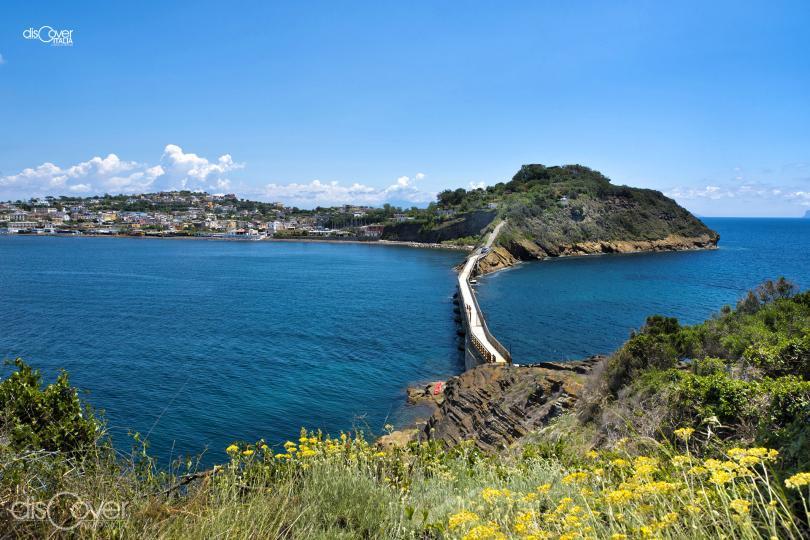
Joining Procida to Vivara is the aqueduct bridge, a 362 meter pedestrian path suspended over the sea, full of suggestions and panoramic views until arriving at Punta Capitello. At the end of the bridge begins the long path that crosses Vivara from Punta Capitello, in the north-east, to Punta Mezzogiorno, on the opposite side, in the south-east.
Approximately 35 hectares wide, with a perimeter of three kilometers and a maximum height of 109 metres, Vivara has rather high coasts and, in various sections, decidedly steep, so it is not accessible from the sea. It was still so, however, when the Mycenaeans in the 16th century BC made it their northernmost port of call in the Tyrrhenian Sea. It was the archaeologist Giorgio Bucher who was the first to identify traces and finds of the Minoan presence at Punta Capitello in 1937. New excavation campaigns since 1976 have brought to light three settlements in Punta Capitello to the north, Punta Mezzogiorno to the south and Punta d'Alaca to the west. Ceramic and metal objects from that phase have been found.
The name Vivara appeared several centuries later, probably borrowed from the fish farm, "vivarium", that the Romans kept in the small gulf of Gènito. The islet was also a hunting oasis. And it remained so afterwards, until the nineteenth century. The only residential building was built in 1681 by Giovanni de Guevara, from whose name, according to another hypothesis, that of Vivara was derived. That structure later became a Bourbon hunting lodge. In the Napoleonic period, the islet was used as a military outpost on the sea and the fortifications still visible date back to that time.Two centuries later, in the 14th century, the Procida settlements were abandoned.
Of the dense oak woods that covered it in ancient times, only a few patches remain on the eastern side. In the nineteenth century, the forest was sacrificed to vines and olive trees. From that period remains, in the centre of the islet, the farmhouse next to the residence also used by the king during hunting trips. And the cistern, the oil mill, the millstone with the domed roof, the stable and the tower for hunting doves. Agricultural activity was interrupted in the 1960s and the islet remained uninhabited. A phase of abandonment then began, which saw the Mediterranean scrub progressively prevail.
The natural oasis is an ideal reference point for as many as five hundred species of birds. About a hundred are sedentary, others are transient during the autumn and spring migrations. And in fact Vivara is also a ringing area for migrants. Rare species of small mammals and insects are the subject of studies. In 1981, a new species of insect called Peliococcus vivarensis was also discovered.
Today Vivara is a State Natural Reserve and its sea is part of the Kingdom of Nettuno Marine Protected Area.